
Your P&L shows how a month went. Your balance sheet shows where your business stands on a single day: what it owns, what it owes, and what’s actually yours. It’s the first report a lender asks for, and most owner-operators have never really read one.
The One Rule: It Always Balances
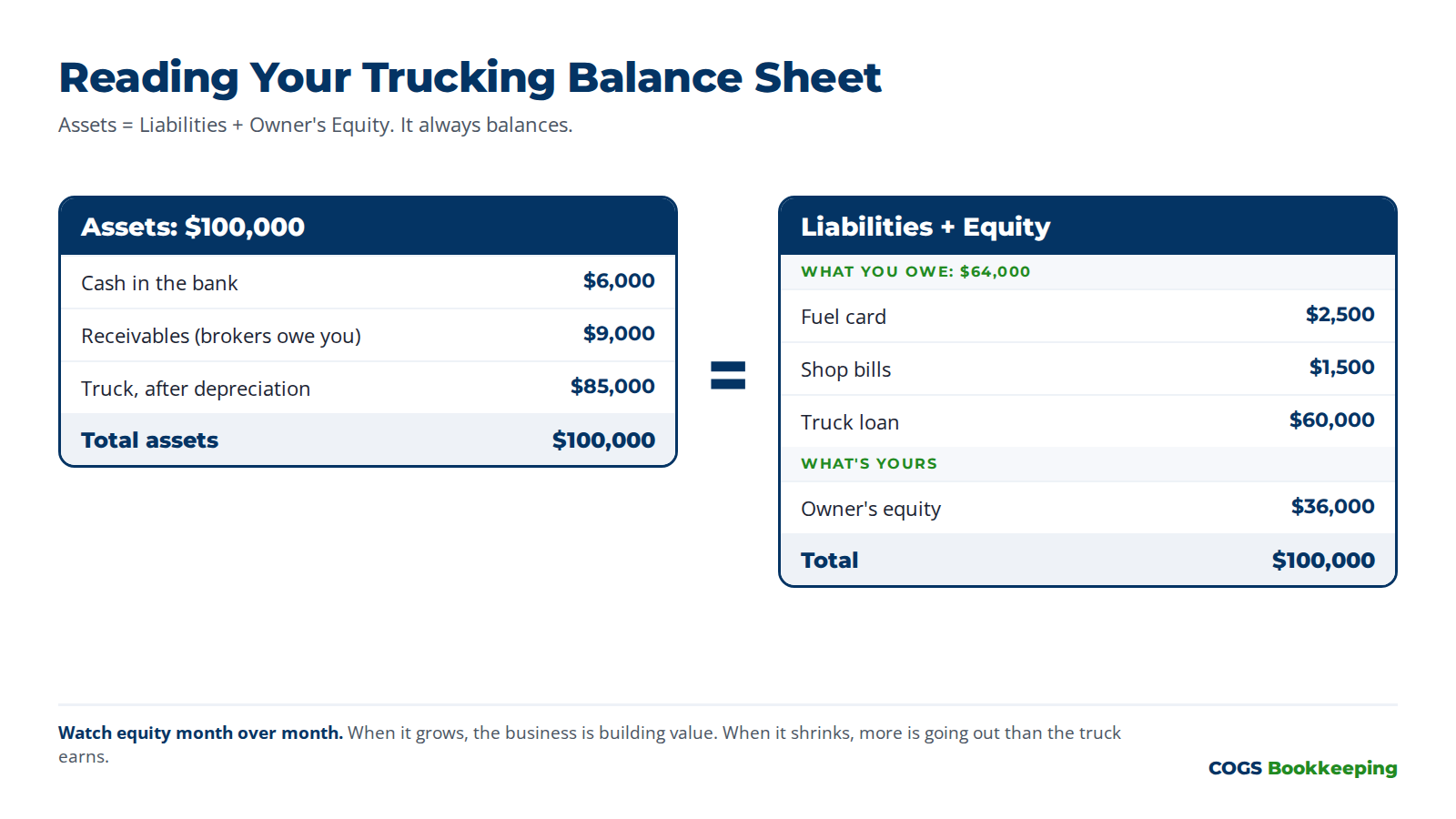
Every balance sheet follows one equation:
Assets = Liabilities + Owner’s Equity
What you own equals what you owe plus what’s yours. If the two sides don’t match, something in the books is wrong.
Assets: What the Business Owns
Cash in your business accounts
Accounts receivable: loads delivered that brokers haven’t paid yet
Factoring reserve: money the factoring company is holding for you
Truck and trailer: what you paid, minus the depreciation recorded so far
Liabilities: What the Business Owes
Fuel card balance
Accounts payable: shop bills, tires on terms, parts
Taxes owed but not yet paid, like IFTA
Truck and trailer loans
Owner’s Equity: What’s Yours
Equity is what’s left when you subtract what you owe from what you own. It grows when you keep profit in the business, and it shrinks when you take draws or the business loses money.
A Simple Example
Assets: cash $6,000, receivables $9,000, truck (after depreciation) $85,000. Total: $100,000.
Liabilities: fuel card $2,500, shop bills $1,500, truck loan $60,000. Total: $64,000.
Owner’s equity: $100,000 − $64,000 = $36,000.
$100,000 of assets = $64,000 of liabilities + $36,000 of equity. It balances.
What to Watch
Is equity growing? If your equity goes up month over month, the business is building value. If it keeps shrinking, you’re taking out more than the truck earns.
Can you cover what’s due soon? Compare cash plus receivables against bills due in the next few weeks. Lenders call this working capital.
How much do you owe compared to what’s yours? In the example, debt is about 1.8 times equity. Lenders watch that number and like to see it come down over time.
For more on why your truck shows up on both sides, read Your Truck Is an Asset. Your Truck Payment Is a Liability.
COGS Bookkeeping produces your balance sheet every month, reconciled and ready for a lender. Get a free evaluation.
Common Questions
What is the difference between a balance sheet and a P&L?
A P&L shows revenue, expenses and profit over a period, such as a month. A balance sheet shows one day: what the business owns, what it owes, and what is left for you.
Why does my truck show up on both sides of the balance sheet?
The truck itself is an asset, recorded at what you paid minus depreciation so far. The loan on the truck is a liability. The difference between the two is part of your equity.
What do lenders look for on a trucking balance sheet?
Equity that grows over time, enough cash and receivables to cover the bills due soon, and a debt load that is reasonable compared with what you own outright.
How often should I look at my balance sheet?
Monthly, after the books are reconciled. Watching it month to month shows whether the business is building value or whether more is going out than the truck earns.