
Ask most owner-operators whether their truck is an asset and they will say yes. Ask them whether that same truck is a liability and they will look at you sideways.
Both answers are correct. And that is exactly why this topic trips people up.
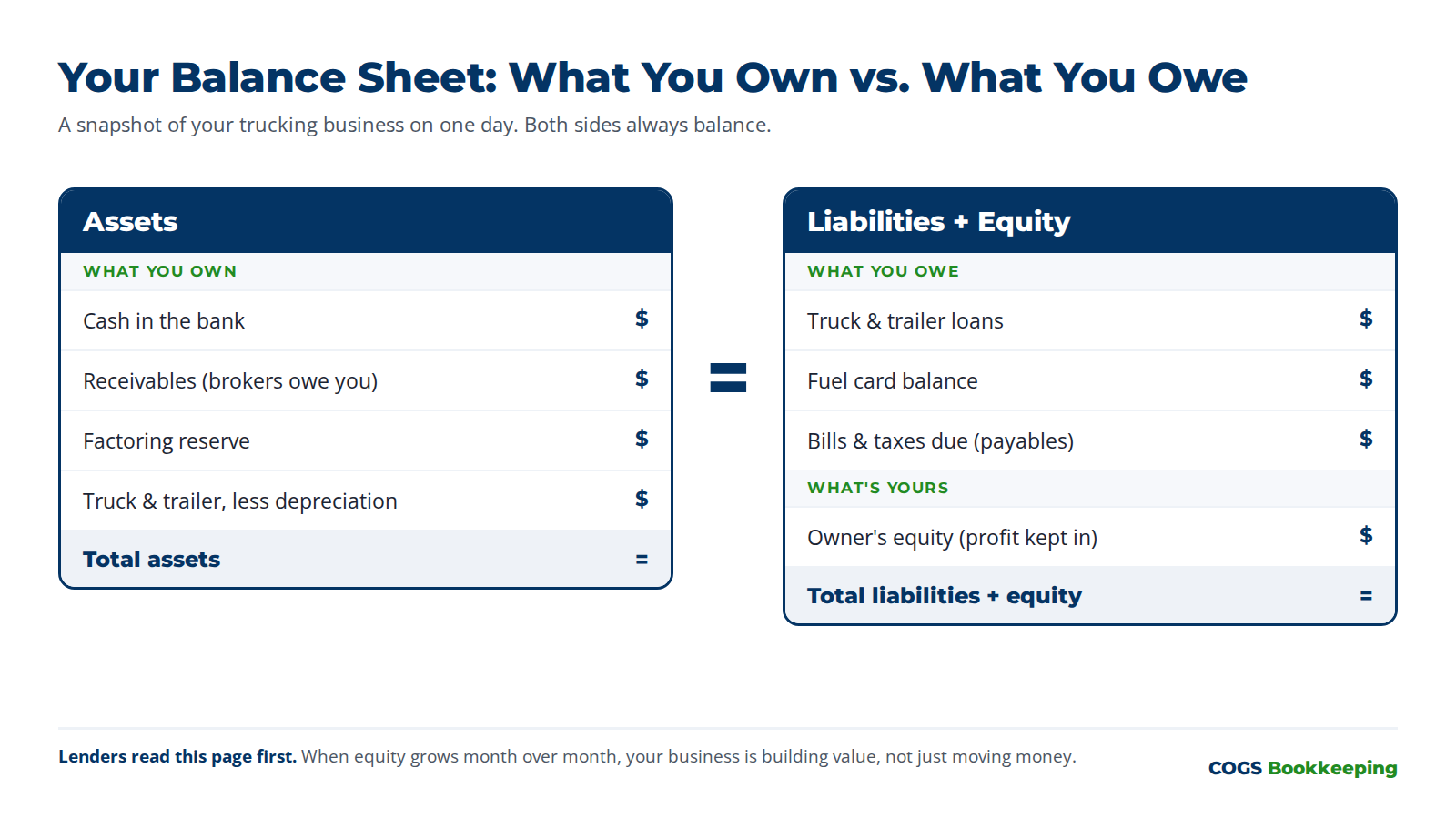
Assets and liabilities are not good and bad. They are not “things I like” and “things I hate.” They are the two sides of your balance sheet, and they tell you what you actually own versus what you actually owe. If you cannot separate the two in your own business, you cannot tell whether you are building equity or slowly going broke while staying busy.
Here is the breakdown, in trucking terms.
What an Asset Actually Is
An asset is something of value that your business owns or is owed. It can be converted into cash, or it generates value over time.
Current assets — things that will turn into cash within a year:
Cash in your operating account — the money you actually have access to
Accounts receivable — settlements you have earned but not yet been paid for, including money tied up with factoring companies and reserves they are holding
Fuel advances owed back to you — if you advanced fuel on a load and the broker has not settled yet
Prepaid expenses — insurance premiums you paid upfront that cover future months
Escrow held by a carrier or broker — if you are leased-on and have money sitting in escrow, that is your asset
Non-current assets — long-term holdings:
Your truck — what you paid for it, minus the depreciation recorded so far (its book value). A lender may also ask what it would sell for, but your books carry it at cost minus depreciation
Your trailer — same principle
Equipment you own outright — APUs, reefers, chains, tarps, tools
Goodwill or authority value — if you built a book of business with your own MC number
If it has value and you own it or are owed it, it is an asset.
What a Liability Actually Is
A liability is something you owe. It is an obligation that will require payment in the future.
Current liabilities — due within a year:
Accounts payable — what you owe to shops, parts suppliers, and vendors
Fuel card balance — the amount outstanding on your fuel card right now
Truck payment due — the portion of your note due in the next twelve months
Insurance premium due — if you pay monthly or quarterly
IFTA owed — fuel tax you have collected but not yet remitted
Payroll owed to drivers — wages earned but not yet paid
Factoring reserve — money the factor is holding back from your invoices
Fuel advances you owe back — money a broker advanced you against a load
Non-current liabilities — due after a year:
The remaining balance on your truck loan — beyond the next twelve months
Trailer loan balance
Equipment financing
Any long-term debt
If you owe it, it is a liability.
The Truck Example That Makes It Click
This is where most people get confused, so let us walk through it.
You buy a truck for $85,000. You put $15,000 down and finance $70,000.
On your balance sheet:
Your truck is an asset of $85,000, what you paid, and that number goes down each month as you record depreciation
Your truck loan is a liability of $70,000
Your equity in the truck is $15,000 — the difference between what it is worth and what you owe
Every month you make a payment, two things happen:
The loan balance goes down (liability decreases)
Your equity goes up (you own more of the truck)
The truck itself does not change. What changes is how much of it you actually own.
This is why a truck can be both an asset and a liability at the same time. It is an asset because it has value and generates revenue. It is a liability because you owe money against it.
Common Questions
Is my truck an asset or a liability?
The truck is an asset, something your business owns. The loan on the truck is a liability, something your business owes. They are two separate items on your balance sheet.
How do I know how much equity I have in my truck?
On your books, take the truck's value after depreciation and subtract what you still owe on the loan. What is left is your equity in the truck.
Are escrow and prepaid insurance assets?
Yes. Escrow held by a carrier or broker is money owed back to you, and insurance paid in advance covers future months. Both are assets.
Why does the difference between assets and liabilities matter?
It shows whether you are building value or just staying busy. If what you owe grows faster than what you own, the business is going backwards even if it feels profitable.