
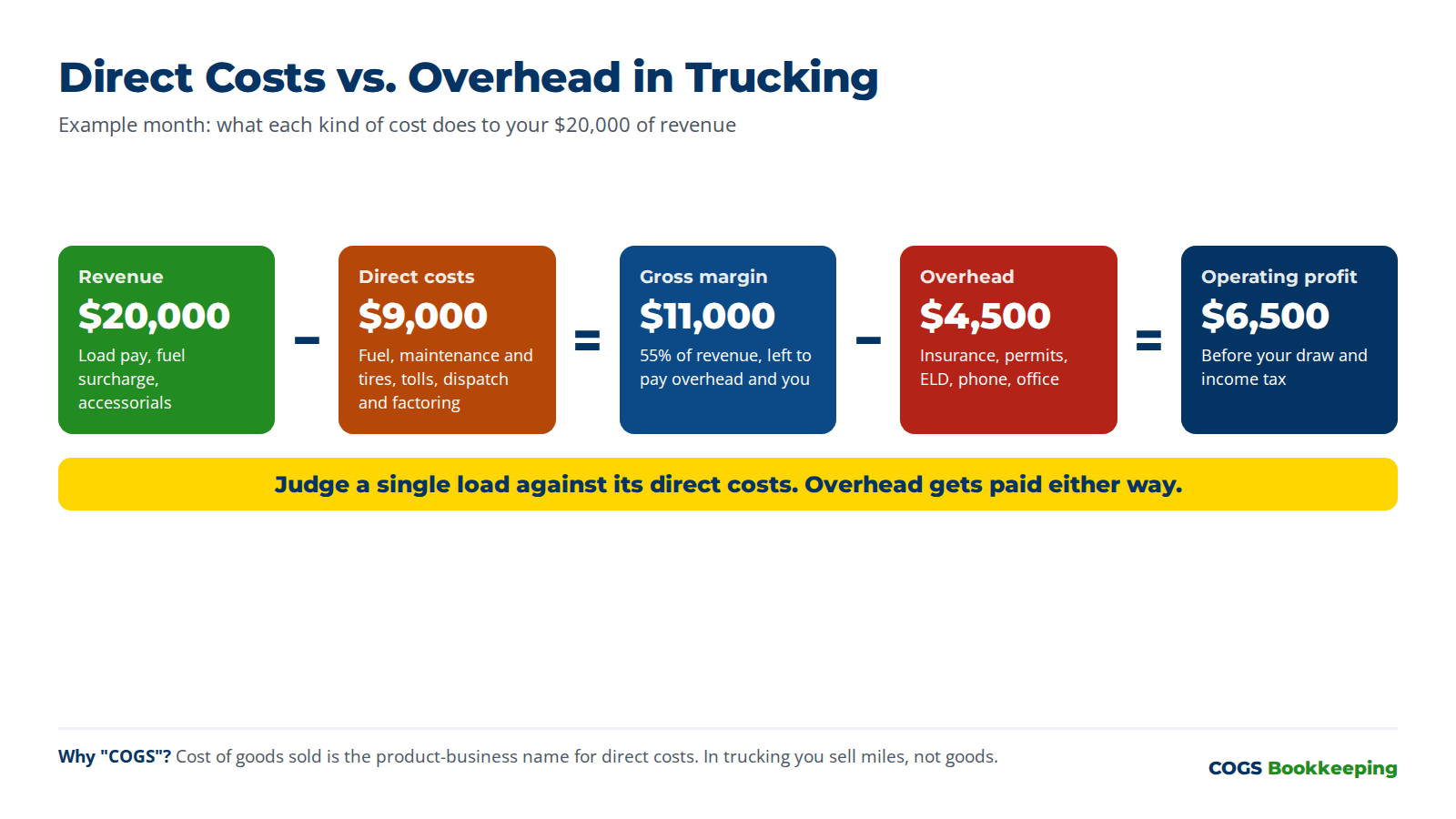
“Cost of goods sold” is a term from businesses that sell products: what the store paid for the things it sold. A trucking company doesn’t sell goods. It sells miles. But the idea behind it, separating the costs of hauling from the costs of running the business, is one of the most useful ways to look at your numbers. (It’s also where our name comes from.)
Direct Costs: What It Costs to Haul
Direct costs go up when you run more loads and down when you run fewer. In trucking this is often called cost of revenue. It includes:
Fuel and DEF
Driver pay, if you run drivers
Maintenance, repairs and tires
Tolls and scales
Per-load fees: dispatch and factoring
Overhead: What It Costs to Be in Business
Overhead stays about the same no matter how many loads you haul:
Insurance
Permits and registration
ELD, phone, load boards and software
Bookkeeping, accounting and office costs
The Number in the Middle: Gross Margin
Revenue minus direct costs is your gross margin. It’s what’s left from your loads to pay overhead and pay you.
Example month:
Revenue: $20,000
Direct costs: fuel $6,000, maintenance and tires $1,600, tolls $400, dispatch and factoring $1,000 = $9,000
Gross margin: $20,000 − $9,000 = $11,000 (55% of revenue)
Overhead: $4,500
Operating profit: $11,000 − $4,500 = $6,500
Why Splitting Them Helps
Load decisions: to judge one load, compare its pay to its direct costs. Overhead gets paid either way, so a load that covers its direct costs and adds some margin may still be worth taking in a slow week.
Trouble spotting: if your gross margin percentage drops, something in the hauling changed: fuel, rates, deadhead or repairs. If overhead creeps up, look at insurance and subscriptions.
Growth decisions: adding a truck adds direct costs and some overhead. Knowing the split tells you how many more loads it takes to make the new truck pay.
For ways to bring both kinds of cost down, read 5 Ways Owner-Operators Can Cut Overhead.
COGS Bookkeeping sets up your books so direct costs and overhead are tracked separately every month, and your gross margin is right there on your P&L. Get a free evaluation.
Common Questions
What does cost of goods sold mean in trucking?
In trucking it means your direct costs, also called cost of revenue: the costs that rise and fall with the loads you run, such as fuel, driver pay, maintenance, tires, tolls, and dispatch and factoring fees.
What counts as overhead for an owner-operator?
Costs that stay about the same no matter how many loads you haul: insurance, permits and registration, ELD, phone, load boards and software, and bookkeeping and office costs.
What is gross margin and how do I use it?
Gross margin is revenue minus direct costs. Watch it as a percentage month to month. If it drops, something in the hauling changed, such as fuel, rates, deadhead or repairs.
Should I take a load that only covers its direct costs?
Sometimes. Overhead gets paid whether the truck moves or not, so in a slow week a load that covers its direct costs and adds a little margin can still help. You cannot run that way all the time, though.