
Plenty of owner-operators have a month where the P&L says they made money and the bank account says they didn’t. Both can be true at the same time. Profit and cash are two different things, and the gap between them is where good businesses get into trouble.
Profit Is What You Earned. Cash Is What You Have.
Your P&L shows what you earned in a month: loads delivered minus the costs of running the truck. Your bank account shows what actually came in and went out. Those don’t line up because money moves on a different schedule than the work.
Here’s a typical month:
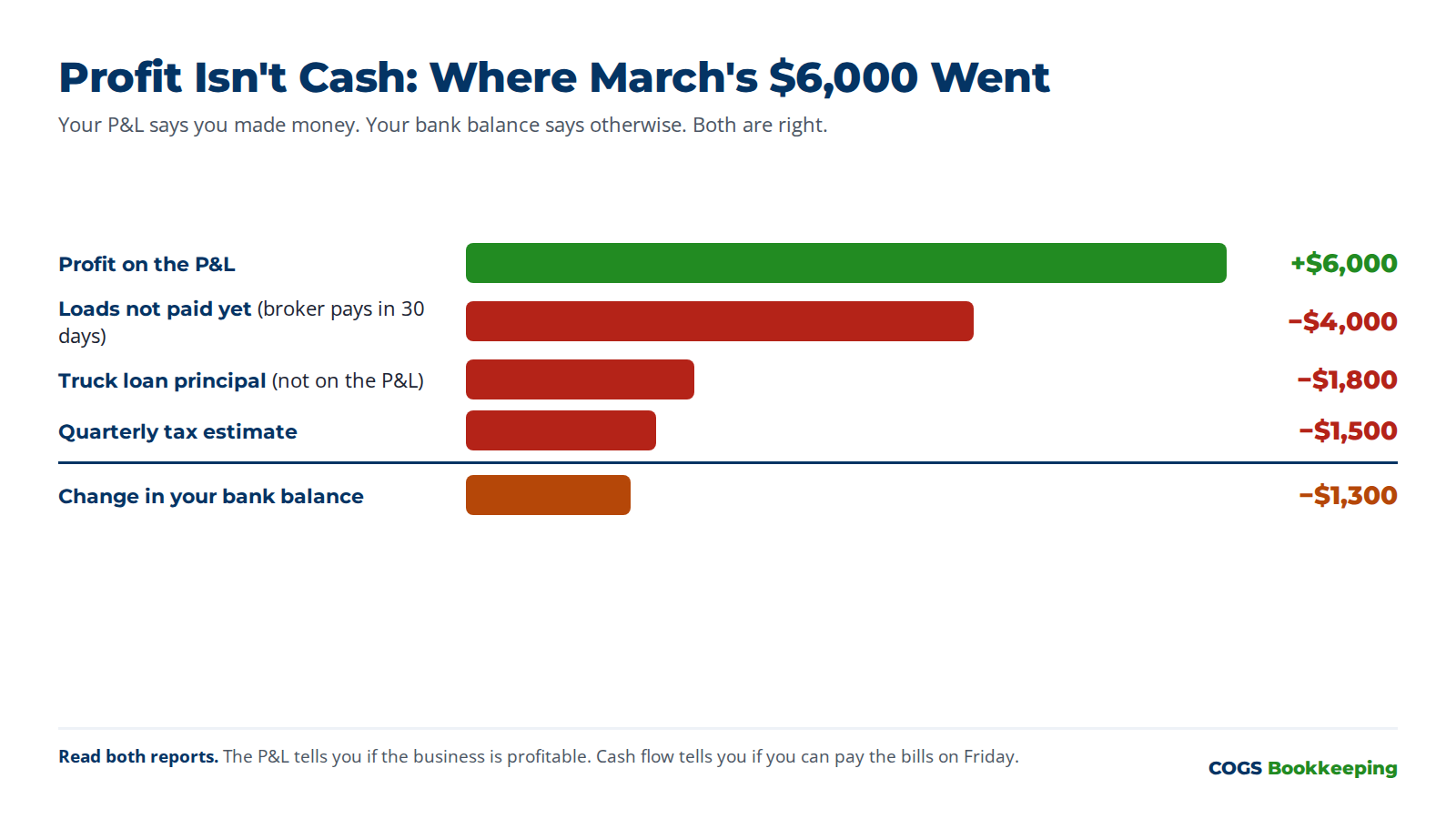
Your P&L says you made $6,000 in March.
$4,000 of March loads haven’t been paid yet. The broker pays in 30 days, so that money lands in April.
Your truck note includes $1,800 of principal. Principal isn’t an expense, so it doesn’t show on the P&L, but it still leaves your account.
You paid a $1,500 quarterly tax estimate.
Six thousand dollars of profit, and your bank balance actually went down $1,300. Nothing is wrong with the books. That’s just how cash moves in trucking.
Where Cash Gets Stuck
Receivables: brokers paying in 30 to 60 days, or later.
Factoring reserves: the part the factoring company holds back until the broker pays.
Truck and trailer principal: real money out that never hits the P&L.
Taxes on a schedule: IFTA every quarter, the annual 2290, and quarterly estimates.
Big repairs and tires: they don’t wait for a good month.
How to Stay Ahead of It
Look ahead weekly. List what’s coming in (which brokers, which dates) and what’s going out (fuel card, insurance, note, taxes) for the next few weeks. A simple list beats a surprise.
Know how fast each broker pays. A good rate from a broker who pays in 60 days can hurt more than a slightly lower rate from one who pays in 15.
Use separate accounts. One for operating, one for taxes, one for maintenance. Move money into the tax and maintenance accounts every time you get paid.
Weigh factoring honestly. Factoring turns receivables into cash fast, but the fee comes out of every load. Know what it costs you per mile. (See The Broker Owes You $8,000.)
Build a cushion. Aim to keep at least a month of fixed costs in the bank so one slow-paying broker doesn’t become a crisis.
Read Both Reports
Your P&L tells you whether the business is profitable. Your cash flow tells you whether you can pay the bills on Friday. You need both. (More on profit in Your P&L Is Lying to You.)
COGS Bookkeeping gives owner-operators a monthly P&L, balance sheet and cash flow in plain English, so you can see the gap before it catches you. Get a free evaluation.
Common Questions
Why do I have no money when my P&L shows a profit?
Your P&L counts a load when you deliver it, but the cash shows up when the broker pays, often 30 days or more later. Truck loan principal, owner draws and tax payments also take cash without showing up as expenses on the P&L.
How much cash should an owner-operator keep in reserve?
A common target is at least one to two months of fixed costs (truck payment, insurance, permits) in the bank, plus a separate repair fund that you add to every week.
Does factoring fix cash flow problems?
Factoring gets you paid in days instead of weeks, for a fee on each invoice. It fixes timing. It does not fix rates or costs that are too thin. If the business loses money per mile, factoring just helps you lose it faster.
How often should I check my cash flow?
Every week, compare what is in the bank with the bills due in the next two to four weeks. Every month, compare how much your cash changed with your profit, and find out where the difference went.