
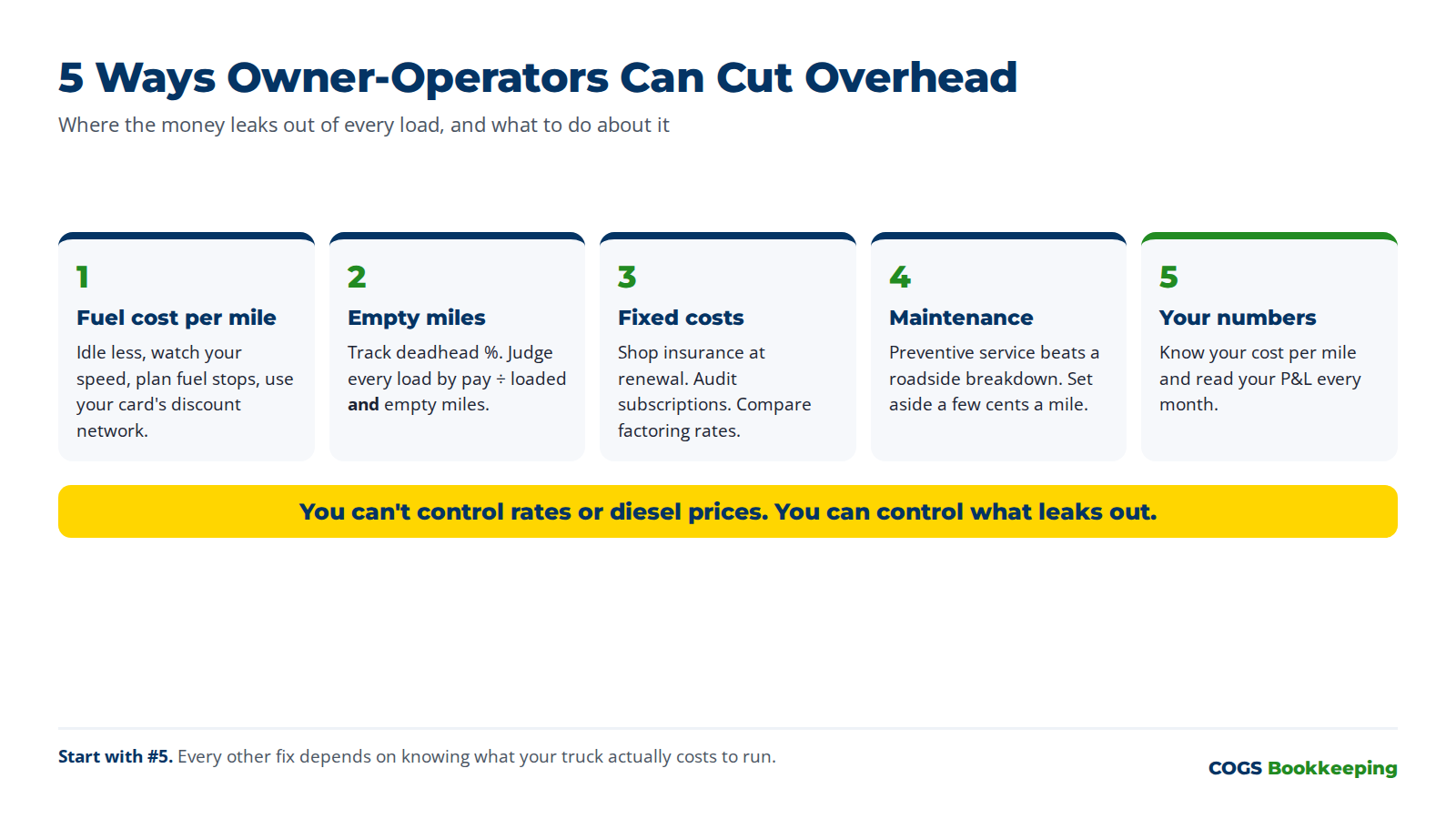
You can’t control the rate a broker offers or what diesel costs this week. You can control how much of every load’s money leaks out before it reaches your pocket.
Most owner-operators don’t go under because they can’t find freight. They go under because the truck costs more to run than they realize, and nobody shows them where the money is going until it’s gone. Margins in trucking are thin, so a few cents a mile in leaks can be the difference between a good year and a bad one.
Here are five places to look, in the order they usually matter most.
1. Cut Your Fuel Cost Per Mile
Fuel is the biggest check you write, so small improvements here add up faster than anywhere else.
Idle less. A heavy truck idling burns roughly 0.8 gallons an hour, according to the U.S. Department of Energy, for zero miles. An APU, a bunk heater or shore power at the truck stop pays for itself if you sleep in the truck often.
Watch your speed. Fuel economy drops quickly at highway speeds. Running a few miles an hour slower on long stretches is one of the cheapest savings you’ll find.
Plan your fuel stops. Prices can swing a lot between states and between stops on the same route. Plan where you fuel instead of filling up wherever the light comes on.
Use your fuel card’s discount network and check that the discount actually shows up on your statement every month.
Track your miles per gallon every month. A sudden drop is often the first sign of a maintenance problem.
2. Cut Your Empty Miles
Deadhead miles burn fuel, wear tires and put hours on the engine, and they pay you nothing.
Know your deadhead percentage. Divide your empty miles by your total miles each month. If you don’t know the number, you can’t improve it.
Judge a load by its all-in rate. A $3.00-a-mile load with 150 empty miles to get to it may pay less than a $2.60 load that picks up down the street. Divide the total pay by loaded and empty miles.
Plan the backhaul before you take the headhaul. A lane that strands you somewhere with no freight back costs you twice.
3. Shop Your Fixed Costs Once a Year
Fixed costs hit every month whether the truck moves or not, and they tend to creep up quietly.
Insurance: get competing quotes at every renewal. Loyalty rarely gets you the best price.
Subscriptions: ELD, load boards, phone plans, software. List everything that bills you monthly and cancel what you don’t use.
Factoring: compare your rate, reserve and fees with other factoring companies, and ask about lower rates once you have a track record.
Your truck note: if your credit or your books have improved since you bought the truck, ask whether refinancing makes sense.
4. Pay for Maintenance Before It Pays You a Visit
A breakdown on the road costs far more than the repair itself: the tow, the roadside rate, the missed load and sometimes a hotel.
Stick to a preventive maintenance schedule for oil, filters, brakes and inspections.
Check tire pressure. Underinflated tires wear out faster and cost you fuel.
Set aside a maintenance reserve every mile. Put a few cents per mile into a separate account so a big repair is a planned expense, not an emergency.
Pay shop invoices on time. A shop that trusts you fits you in when you break down. One you owe money to doesn’t. (More on that in Accounts Payable for Truckers Explained.)
5. Know Your Numbers Every Month
You can’t cut what you can’t see. Every tip above depends on knowing what the truck actually costs to run.
Know your cost per mile. Add up everything the truck cost you this month and divide by the miles you ran. Try our free Cost-Per-Mile Calculator.
Read your P&L every month, not just at tax time. It shows which costs are growing before they become a problem. (See Your P&L Is Lying to You.)
Keep business and personal money separate so the numbers mean something.
Clean, current books turn all of this from guesswork into a plan. That’s what COGS Bookkeeping does for owner-operators and small fleets: monthly books, your true cost per mile and a P&L in plain English, so you know exactly where your money goes. Get a free evaluation.
Common Questions
What is the biggest cost for most owner-operators?
Fuel is usually the biggest check you write, so small savings per mile there add up faster than anywhere else.
How much fuel does idling burn?
A heavy truck idling burns roughly 0.8 gallons an hour, according to the U.S. Department of Energy, while covering zero miles. An APU, a bunk heater or shore power can pay for itself if you sleep in the truck often.
How do I find my cost per mile?
Add up everything the truck cost to run for a month, including fixed costs, and divide by the total miles driven, loaded and empty. The free Cost-Per-Mile Calculator on this site does the math for you.
What are fixed costs in trucking?
Costs that do not change with miles: the truck payment, insurance, permits, ELD and phone, and software. Lowering them lowers your break-even rate on every load.